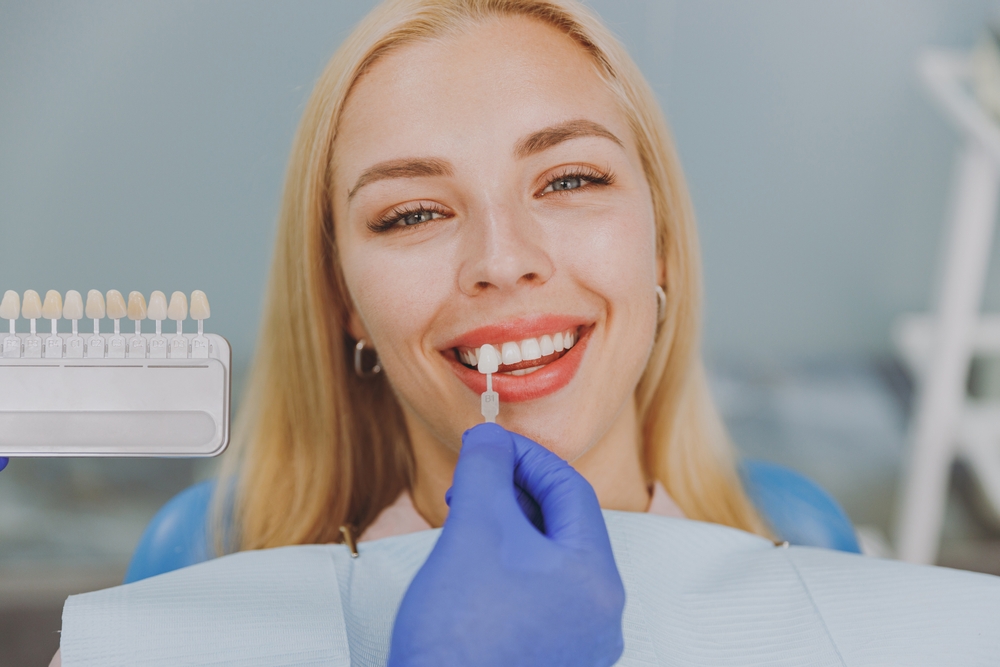
When people speak of “bonding” their teeth to make them look better, they are usually referring to either porcelain or resin veneers. Veneers cover only the outside portion of the tooth, the part that shows when you smile or talk. In fact, all tooth-colored dental restorative materials are bonded, whether the restoration is in a front tooth or a back tooth. Strictly speaking, in dentistry, bonding refers only to adhesive joining of two dissimilar materials. Silver fillings can be bonded, as can crowns (caps).
Porcelain and resin veneers are placed in order to correct slight or severe defects in tooth alignment, shape, or color. They are also placed when teeth have been moderately restored and the teeth have been weakened. This is done when there is still enough enamel left for the bonding to be successful. If the teeth are in very poor alignment or there is insufficient enamel remaining, bonding to improve the appearance is not possible. At that point orthodontics or full-coverage crowns must be considered. The most common use for bonding veneers, either porcelain or resin, is to improve the cosmetic appearance of the patient.
Without question, porcelain veneers look the best and last the longest. They are indicated when the teeth are in fair to good alignment or when a more pleasing tooth color is desired. They are not usually placed in a patient under 16 years of age. The procedure usually requires some slight to moderate tooth preparation (drilling).